
Air coolers in Malaysia run RM299 to RM999. The value pick is the Pensonic PAC-104M at RM299, and the pick for a larger space is the Khind EAC200 at RM599 with a 20 L tank.
Before you buy one, understand what it can physically do. An evaporative air cooler cools by evaporating water, and its maximum possible cooling is set by how much moisture the air can still absorb. In Malaysian humidity that limit is roughly 3°C on a good afternoon and under 2°C on a humid one. Call it the Wet-Bulb Ceiling. The same machine in a desert would deliver 13°C.
They are still cheap to run. A 65 W cooler costs around RM4.70 a month against roughly RM54 for a 1.0 HP portable aircon on the same eight hours a day, a saving near RM590 a year.
But the top of this range now overlaps with portable air conditioning. At RM999 you can buy either the Firenzzi FAC-1890 air cooler or a Morgan 1.0 HP portable aircon, and only one of those is limited to 3°C.
Ordered by price, low to high.
Every hot week in Malaysia, someone buys an air cooler, runs it for an evening, and concludes it does nothing. They are not quite right, and the reason they are wrong is worth understanding before you spend RM299 or decide not to.
How does an air cooler actually work?
Quick Answer: An evaporative air cooler pulls warm air through a wet pad. Water evaporates into that air, and the energy required to turn liquid water into vapour is taken from the air itself, which comes out cooler and wetter. There is no compressor and no refrigerant. An air conditioner does something completely different: it moves heat out of the room through a refrigeration cycle and vents it outside, which is why it needs an outdoor unit or an exhaust hose.
Three consequences follow from that difference, and they explain nearly everything about how these machines behave.
- A cooler adds humidity. Aircon removes it. They are opposites on moisture, not variations on cooling.
- A cooler needs an open window. Aircon needs a closed one. Air coolers work by conditioning a stream of fresh air passing through the room. Seal the room and the air saturates, at which point evaporation stops and so does the cooling.
- A cooler removes no heat from the building. It redistributes energy between temperature and humidity. The total heat in the room is essentially unchanged.
Key takeaway: An air cooler is a fan that trades humidity for temperature. Whether that trade is worth making depends entirely on how much dry capacity your air has left, which in Malaysia is not much.
The Wet-Bulb Ceiling: how much cooling is physically available
Quick Answer: The maximum cooling an evaporative cooler can deliver equals the gap between the air’s current temperature and its wet-bulb temperature, which is the lowest temperature achievable by evaporation alone. As humidity rises, wet-bulb approaches air temperature and that gap closes. Real coolers achieve roughly 80% of it. In Kuala Lumpur conditions the ceiling is about 3°C, and on a humid day under 2°C.
| Condition | Wet-bulb temp | Maximum possible drop | Realistic drop at 80% efficiency |
|---|---|---|---|
| KL typical afternoon, 32°C at 75% RH | 28.3°C | 3.7°C | 3.0°C |
| KL humid day, 32°C at 85% RH | 29.8°C | 2.2°C | 1.7°C |
| KL evening, 29°C at 85% RH | 26.9°C | 2.1°C | 1.7°C |
| Dry climate, 32°C at 40% RH | 22.1°C | 9.9°C | 7.9°C |
| Desert, 38°C at 20% RH | 21.3°C | 16.7°C | 13.3°C |
What this table shows: the physical limit on evaporative cooling across five climates, and why the same machine performs very differently in each.
Source: Wet-bulb temperatures calculated using the Stull (2011) empirical approximation for wet-bulb temperature from dry-bulb temperature and relative humidity. Assumptions flagged: the 80% efficiency figure is a typical direct evaporative cooler saturation effectiveness and varies by pad design, airflow and pad condition; manufacturers do not publish it for the Malaysian models in this guide. Temperature and humidity pairs are representative Malaysian and comparison conditions, not measurements from a specific day. The purpose is the contrast between rows.
This is the number that decides whether you should buy one, and no Malaysian product page states it.
It also explains the two things people report. The air from the vent genuinely feels cold, because right at the pad the air is close to wet-bulb temperature and moving fast. But the room temperature barely moves, because the ceiling on whole-room cooling is 2°C to 3°C and the machine is simultaneously raising humidity, which makes a given temperature feel warmer.
There is a real trick that beats the ceiling, and it is the ice pack tray most Malaysian models include. Ice cools by melting rather than evaporating, which is a separate mechanism not bound by wet-bulb temperature. It works, it is short-lived, and it is why these machines ship with two ice packs.
Key takeaway: In Malaysia, expect around 3°C from an air cooler and treat anything more as a bonus from ice packs. If a listing implies aircon-like performance, it is describing the vent, not the room.
How we ranked this list
Four criteria, weighted:
- Verified RM price from a named Malaysian retailer as of 14 August 2026.
- Published tank capacity and power draw, since these determine refill frequency and running cost.
- Suitability for the spaces where evaporative cooling actually works, meaning ventilated and semi-outdoor areas rather than sealed bedrooms.
- Warranty and Malaysian service presence.
What would disqualify an entry: no verifiable RM price from a Malaysian seller. This excluded several Midea models that appear on retailer category pages without listed prices, including the MAC-120AR, MAC-107AR and MAC-450CR. The only MAC-120AR price we found, RM449, came from a source dated 2024 and we will not present it as current.
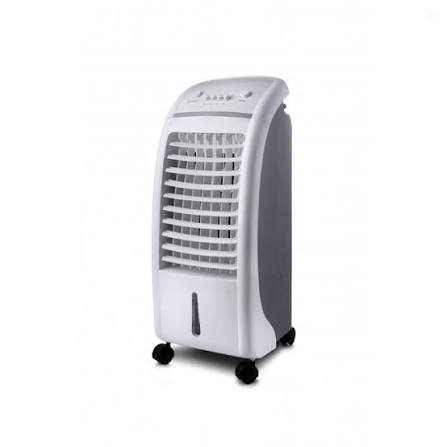
1. Pensonic PAC-104M 7 L (RM299)
Specifications: 7 L water tank, 65 W, 3-speed fan, sprinkling system, SIRIM compliant. RRP RM365.
Our value pick. The cheapest credible air cooler from a Malaysian brand with local service, and at 65 W it costs roughly RM4.70 a month to run for eight hours a day.
The 7 L tank is the constraint. In continuous use expect to refill daily, and note that a small tank on a hot day is a machine that runs dry and stops.
Who it suits: a first air cooler, a bedside unit, or a small study.
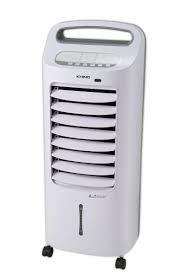
2. Khind EAC600 6 L (RM339)
Specifications: 6 L tank, 65 W, effective area 10 m², 3 fan speeds, 7-hour timer, wide-angle oscillation, sleep mode, auto shut-off pump protection, remote control, two ice packs included. RRP RM398.
The one model here that publishes an effective area, and the figure is honest: 10 m². That is a small bedroom or a study, not a living room, and Khind saying so plainly is worth more than a competitor claiming vaguely larger coverage.
Sleep mode is the differentiator. Air coolers are pump-and-fan machines and the pump is the noisier half, so a mode that manages both is genuinely useful overnight.
Who it suits: bedrooms up to 10 m², and anyone who wants a published coverage figure to check against.
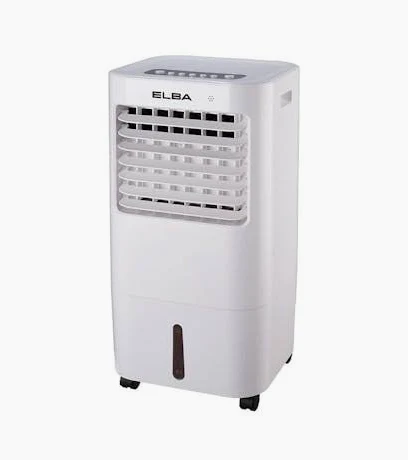
3. Elba EAC-H6580RC 14 L (RM379)
Specifications: 14 L water tank, digital control panel, remote control. RRP RM552.
Double the tank of the entries above at a modest premium, which in practice means running through an evening without a refill. Elba does not publish power draw or effective area on the retail listing.
Who it suits: buyers who want longer unattended running and do not need published specifications.
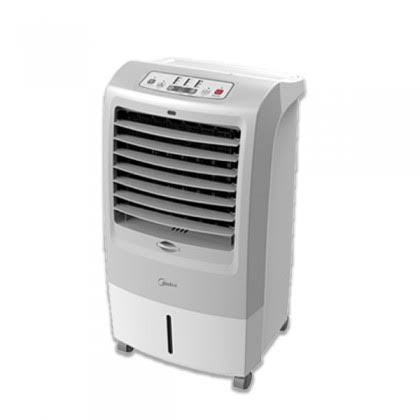
4. Morgan MAC-COOL1B 10 L (RM399)
Specifications: 10 L water tank, remote control. RRP RM539.
Morgan sits mid-range across this category and this is the entry model. A 10 L tank is the sensible middle: enough for a full evening, not so large that the unit becomes hard to move when full.
Remember that a full 10 L tank adds 10 kg to the machine. Fill it where it will stand.
Who it suits: general home use where the cooler stays in one room.
5. Khind EAC200 20 L (RM599)
Specifications: 20 L water tank, 200 W, ioniser function, digital display, remote control, centrifugal blades, 1, 2, 4 and 8-hour timer, low water alarm, vertical and horizontal swing, 12.45 kg, 37 × 33 × 100 cm, 2-year warranty. RRP RM818.
Our pick for larger spaces. The 20 L tank and centrifugal blade design put this in a different class from the 6 to 10 L units, and the two-year warranty is the longest here against the one year most competitors offer.
At 200 W it draws three times what the entry models do, which is still only about RM14.40 a month on eight hours a day. The vertical and horizontal swing matters more than it sounds, because evaporative cooling depends on air movement across skin as much as on air temperature.
Who it suits: living rooms, semi-outdoor areas, workshops, and anywhere you want a full day of running between refills.
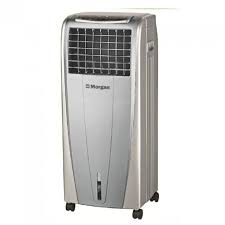
6. Morgan MAC-COOL3 10 L (RM599)
Specifications: 10 L water tank. RRP RM829.
The step up in Morgan’s range at the same price as the Khind EAC200, with half the tank. Morgan does not publish power draw or effective area on the retail listing, which makes the comparison against the Khind difficult to make on anything except brand preference.
Who it suits: buyers already committed to Morgan.
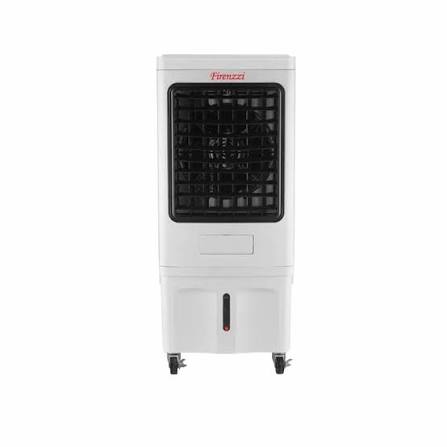
7. Firenzzi FAC-1390 30 L 2-in-1 (price not published)
Specifications: 30 L water tank, combined standalone electric fan and air cooler.
The largest tank in this guide, and the 2-in-1 design means it works as a plain fan when you do not want the humidity, which is a sensible acknowledgement of the physics.
The retailer listing did not show a price at the time of checking. Ask before ordering.
Who it suits: large or semi-outdoor spaces, if you can get a current price.
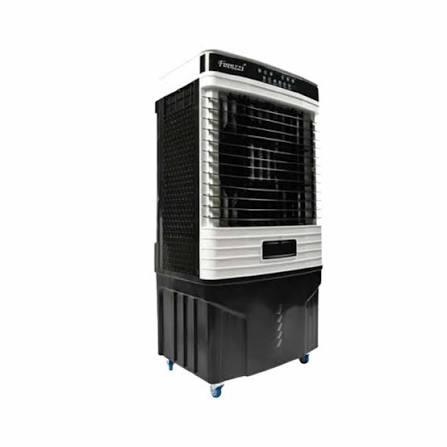
8. Firenzzi FAC-1890 280 W Touch Screen (RM999)
Specifications: 280 W, touch screen control. RRP RM1,670.
The most expensive air cooler here, and the one that raises the question this whole guide is built around. At exactly RM999 the same retailer sells a Morgan 1.0 HP portable air conditioner, and a Midea 1.0 HP portable aircon at the same price.
A portable aircon at that price will drop room temperature by 8°C or more and dehumidify while it does it. This cooler is bound to roughly 3°C and will add humidity. It costs less to run, by about RM34 a month at this wattage, and it needs no exhaust hose. Those are real advantages. But at RM999 the comparison is no longer obvious, and we would not choose the cooler.
Who it suits: genuinely, a semi-outdoor space where a portable aircon cannot vent, and where you want a large touchscreen unit. Otherwise look at the aircon.
What do air coolers cost in Malaysia?
Quick Answer: Between RM299 and RM999 from named Malaysian retailers, with the sensible bracket at RM299 to RM599. Every model we found was on promotional pricing, discounted 19% to 40% below RRP. At the top of the range, portable air conditioners start at the same RM999.
| Model | Price (RM) | RRP (RM) | Tank | Power | Published coverage |
|---|---|---|---|---|---|
| Pensonic PAC-104M | 299 | 365 | 7 L | 65 W | Not published (MY) |
| Khind EAC600 | 339 | 398 | 6 L | 65 W | 10 m² |
| Elba EAC-H6580RC | 379 | 552 | 14 L | Not published (MY) | Not published (MY) |
| Morgan MAC-COOL1B | 399 | 539 | 10 L | Not published (MY) | Not published (MY) |
| Khind EAC200 | 599 | 818 | 20 L | 200 W | Not published (MY) |
| Morgan MAC-COOL3 | 599 | 829 | 10 L | Not published (MY) | Not published (MY) |
| Firenzzi FAC-1390 | Not published | Not published | 30 L | Not published (MY) | Not published (MY) |
| Firenzzi FAC-1890 | 999 | 1,670 | Not published (MY) | 280 W | Not published (MY) |
| Morgan 1.0 HP portable aircon | 999 | 1,299 | n/a | ~750 W | n/a |
| Midea 1.0 HP MPH-09CRN1 portable aircon | 999 | 1,099 | n/a | ~750 W | n/a |
What this table shows: current Malaysian air cooler pricing, with the two portable air conditioners the same retailer sells at the top of the same price band shown in italics for comparison.
Key takeaway: Only one of eight models publishes an effective area, and only three publish power draw. In a category where performance is capped by physics, that gap is the reason most buyers end up disappointed.
What does an air cooler cost to run?
Quick Answer: Very little. At 65 W a small air cooler costs roughly RM4.70 a month running eight hours a day, and even the 200 W Khind EAC200 costs about RM14.40. A 1.0 HP portable air conditioner on the same schedule costs around RM54. The saving against aircon is close to RM590 a year, which is more than the purchase price of most units here.
| Unit | Power | Daily consumption | Monthly cost |
|---|---|---|---|
| Midea MAC-120AR | 60 W | 0.48 kWh | RM4.32 |
| Pensonic PAC-104M, Khind EAC600 | 65 W | 0.52 kWh | RM4.68 |
| Khind EAC200 | 200 W | 1.60 kWh | RM14.40 |
| Firenzzi FAC-1890 | 280 W | 2.24 kWh | RM20.16 |
| 1.0 HP portable aircon | ~750 W | 6.00 kWh | RM54.00 |
What this table shows: running cost at eight hours a day, across the wattages published for these models.
Source: Consumption calculated from published wattage at 8 hours daily use over 30 days. Tariff assumption flagged: costs use an assumed RM0.30 per kWh, which is an illustrative domestic rate. Malaysian domestic tariffs are banded and were restructured in 2025, so your actual rate depends on total household consumption. Recalculate against your own bill. Portable aircon consumption uses an assumed 750 W average draw, which varies with inverter behaviour, ambient temperature and thermostat setting.
This is the honest case for air coolers and it is a strong one. The RM590 annual saving exceeds the purchase price of every model here except the Firenzzi. If your alternative is running aircon in a room you do not need to cool to 24°C, the cooler wins on cost by a wide margin.
Key takeaway: Air coolers are cheap to run, and that is their real argument. Just do not expect the cooling to match the saving.
When an air cooler beats aircon
Four situations where the physics stops mattering and the cooler is the right answer.
Semi-outdoor and open spaces. A patio, porch, car porch, workshop, garage or covered outdoor kitchen. Air conditioning cannot condition an open volume, and an air cooler in a ventilated space is working exactly as designed, with a continuous supply of fresh air to condition.
Rooms where you cannot install aircon. Rented rooms, heritage buildings, condos with no available condenser position, and anywhere a landlord will not permit drilling. A portable aircon still needs a window for the exhaust hose. An air cooler needs a plug and a window that opens.
Events and temporary use. Kenduri, open houses, marquees and outdoor gatherings. There is an established Malaysian rental market for exactly this, with units renting from around RM150.
Where the alternative is nothing. A workshop, a store room or a kitchen at 34°C with a fan is a worse place to be than the same room at 31°C with air moving across you. Three degrees plus airflow is a real improvement over a bare fan, even though it is not aircon.
Key takeaway: Air coolers earn their place where aircon physically cannot go. In a sealed bedroom with an aircon point on the wall, they lose.
When an air cooler is the wrong purchase
Your room is sealed and air-conditioned. You are adding humidity to a machine that is spending electricity removing it, and the two will fight.
You expect it to work with the windows shut. In a 40 m³ bedroom at 32°C and 75% humidity, the air can absorb only about 0.34 litres of water before it saturates. A cooler evaporating half a litre an hour reaches that point within the hour, and once the air is saturated the cooling stops entirely.
Your problem is haze. Air coolers need open windows, and open windows during haze are the one thing our haze guide tells you to eliminate. During an event, an air cooler and an air purifier cannot both do their jobs in the same room.
Your problem is damp. Adding moisture to an already damp room makes it worse. See the dehumidifier guide.
You are looking at the RM999 models. Portable air conditioners start at the same price and are not bound by the Wet-Bulb Ceiling.
We work through payment routes across appliance categories in our guide to buying big-ticket home appliances outright, on rental or by instalment.
Frequently asked questions
Do air coolers actually work in Malaysia? Partly. Evaporative cooling is limited by how much moisture the air can still absorb, and Malaysian air is already close to saturated. Realistic cooling is about 3°C on a typical afternoon and under 2°C on a humid day, against roughly 13°C for the same machine in a desert climate. They move air well and cost little to run, but they will not perform like air conditioning.
How much does an air cooler cost in Malaysia? Between RM299 and RM999 from named retailers, with most useful models at RM299 to RM599. The Pensonic PAC-104M at RM299 is the cheapest credible unit and the Khind EAC200 at RM599 has the largest verified tank at 20 L. Every model we checked was discounted 19% to 40% below RRP.
Is an air cooler cheaper to run than aircon? Substantially. A 65 W air cooler uses about 0.52 kWh a day at eight hours, against roughly 6 kWh for a 1.0 HP portable air conditioner. At an assumed RM0.30 per kWh that is about RM4.70 a month against RM54, a saving near RM590 a year, which exceeds the purchase price of most units in this guide.
Do air coolers need an open window? Yes, and this is the most common mistake. An air cooler works by conditioning fresh air passing through the room. In a closed 40 m³ bedroom the air saturates within about an hour, after which evaporation and cooling both stop. Air conditioning needs the opposite: a sealed room.
Do air coolers make a room humid? Yes, by design. Cooling comes from evaporating water into the room air, so temperature falls and humidity rises together. In Malaysia, where indoor humidity is typically 70% to 90%, that trade is often unwelcome, and it is why an air cooler is a poor choice for a room that already feels damp.
Should I buy an air cooler or a portable aircon? Below RM600, the cooler is the only option in that price band and is a reasonable buy for a ventilated room. At RM999 they overlap directly, and at that price a portable aircon delivers far more cooling and removes humidity rather than adding it. Choose the cooler only where aircon cannot vent, such as a patio or workshop.


