
- On 1 January 2026 Suruhanjaya Tenaga raised the minimum efficiency for a room air conditioner under 4.5 kW from CSPF 3.10 to CSPF 4.10. Published data puts fixed-speed non-inverter units at CSPF 3.4 to 3.5, which is below that floor. We call this the 4.10 Floor, and it is why the inverter question is closing rather than open.
- Verified Malaysian prices run RM869 for a Midea 1.0HP non-inverter to RM3,079 for a Panasonic 2.0HP inverter, before installation of RM250 to RM280.
- The inverter premium is where the real spread sits. Midea charges RM164 more for the 1.5HP inverter. Panasonic charges RM530 for the same step. At 8 hours a day those premiums clear in 4 months and 13 months.
- Four published Malaysian sizing guides disagree. Two work at roughly 51 BTU per square foot, two at roughly 66. At a 250 square foot living room that gap is the difference between 1.5HP and 2.0HP, and about RM700 of unit price.
- Our pick for a standard master bedroom is the Midea 1.5HP inverter at RM1,317. Over ten years at 8 hours a day it undercuts a non-inverter of the same size by about RM4,900 in electricity.
- Rental exists but is thin. LG Subscribe starts at RM75 a month including installation. CUCKOO sells the Vita-S inverter and publishes no price or rental terms we could retrieve.
A neighbour in Puchong replaced a 14 year old 1.5HP non-inverter last March and told me the quote felt like a scam because the cheapest unit in the showroom cost more than the one he bought in 2012. He was right about the price and wrong about the reason: the floor underneath the Malaysian aircon market moved on 1 January 2026, and the cheap units he remembered are no longer legal to sell new.
What changed for Malaysian air conditioners on 1 January 2026?
Suruhanjaya Tenaga’s revised energy-using product guidelines raised the CSPF needed for the 2-star minimum. For units under 4.5 kW, which covers every 1.0HP and 1.5HP wall split, the 2-star band moved from CSPF 3.10 to 3.29 up to CSPF 4.10 to 4.79. Anything below 4.10 is now 1-star, and the guidelines set 2-star as the minimum standard for sale. Published figures put non-inverter units at CSPF 3.4 to 3.5.
CSPF stands for Cooling Seasonal Performance Factor, measured in Wh of cooling per Wh of electricity. A unit at CSPF 4.10 delivers 4.1 units of cooling for every unit of power it draws across a season, and because the figure is seasonal it already accounts for the compressor switching on and off rather than measuring one perfect moment on a test bench.
Here is the schedule as published, for cooling capacity under 4.5 kW:
| Period | 5-star | 4-star | 3-star | 2-star | 1-star |
|---|---|---|---|---|---|
| To 31 Dec 2025 | 5.30 and above | 4.60 to 5.29 | 3.30 to 4.59 | 3.10 to 3.29 | Below 3.10 |
| 2026 to 2029 | 6.09 and above | 5.40 to 6.08 | 4.80 to 5.39 | 4.10 to 4.79 | Below 4.10 |
| 2030 onward | 7.50 and above | 7.00 to 7.49 | 6.50 to 6.99 | 6.09 to 6.49 | Below 6.09 |
CSPF bands in Wh/Wh for single-split wall-mounted units under 4.5 kW cooling capacity. Units of 4.5 kW to 7.1 kW, which covers 2.0HP and 2.5HP, sit about 0.1 to 0.5 points lower at each step. Source: Suruhanjaya Tenaga, Guidelines on Energy-Using Product GP/ST/No.50/2024 (Pind.1/2026), retrieved 7 October 2026, read against Guide on MEPS for Air Conditioners (2018 schedule) for the pre-2026 bands.
Two consequences fall out of that table, and neither is on the showroom label.
The first is that the star rating on a box printed in 2025 does not mean what the same rating means now. A unit at CSPF 5.30 was a 5-star unit last year. In the 2026 band it lands in the 4.80 to 5.39 row, which is 3-star. A unit at CSPF 3.30, a solid 3-star in 2025, is now 1-star and below the minimum. If you are shopping clearance stock, the stars printed on the carton are the old scale.
The second is the 2030 step. The 2-star floor rises to CSPF 6.09, which is above the 5.30 that earned a 5-star rating in 2025. A unit you buy today at 5-star under the old scale would fail the minimum standard in four years. That does not make it illegal to own or run, and nothing in the guidelines requires you to replace it, but it does mean the resale and the parts story for marginal units gets worse, not better.
Key takeaway: ask the dealer for the CSPF figure in Wh/Wh, not the star count. The number is comparable across years and the stars are not.
Can you still buy a non-inverter aircon in Malaysia?
Non-inverter units remain listed by Malaysian sellers in October 2026, including a Midea 1.0HP at RM869 and Acson 1.5HP stock on trade platforms. On the published figures they should not clear the new minimum: fixed-speed units reach CSPF 3.4 to 3.5, and the 2026 floor is 4.10, about 17% above the top of that range. We found no published transition or stock-clearance clause in the guidelines.
This is a real gap between the regulation as written and the market as it looks, and I am not going to resolve it for you by guessing. The three possibilities are that the listings are old stock registered under the 2025 schedule, that price lists have not been updated, or that enforcement runs behind the gazette. The guidelines came into operation on 1 January 2025 under the Energy Efficiency and Conservation Act, gazetted 26 November 2024, with the revised rating schedule applying from 1 January 2026. They contain no clause we could find addressing inventory already manufactured.
What that means for you at the counter is narrow and practical. If a dealer offers a non-inverter at an attractive price in late 2026, the unit is almost certainly pre-2026 stock. Ask for the CSPF and the registration date. A unit at CSPF 3.5 will cost you the gap for its entire service life, and on a 1.5HP at 8 hours a day that gap is RM494 a year against a CSPF 5.50 inverter.
Key takeaway: a non-inverter bargain in 2026 is a 10 year electricity contract at last decade’s efficiency. Get the CSPF in writing before you sign the delivery order.
Is an inverter aircon worth it in Malaysia?
Yes above about two hours of daily use, and the deciding variable is the premium your brand charges rather than your usage. Midea asks RM164 more for the 1.5HP inverter and clears that in 4 months at 8 hours a day. Panasonic asks RM530 for the same step and takes 13 months. Both are inside the first 18 months of a unit that should run 12 to 15 years.
Rather than reuse the running-cost figures circulating on Malaysian renovation blogs, which quote RM80 to RM120 a month for a 1.5HP non-inverter without disclosing the hours or the tariff behind them, we calculated from the two inputs that are published and checkable: the CSPF range for each compressor type, and the current TNB domestic rate.
At 44.43 sen per kWh, a non-inverter at CSPF 3.45 and an inverter at CSPF 5.50 differ by RM3.76 per horsepower, per hour of daily runtime, per month. The constant is steady across sizes because both the cooling load and the efficiency gap scale with capacity.
| Size | Cooling capacity | Non-inverter draw | Inverter draw | Saving per daily hour, per month |
|---|---|---|---|---|
| 1.0HP | 2.64 kW | 765 W | 480 W | RM3.80 |
| 1.5HP | 3.52 kW | 1,020 W | 640 W | RM5.07 |
| 2.0HP | 5.28 kW | 1,530 W | 960 W | RM7.60 |
| 2.5HP | 7.03 kW | 2,038 W | 1,278 W | RM10.12 |
Average input power across a cooling season, derived as cooling capacity divided by CSPF. Non-inverter at CSPF 3.45 and inverter at CSPF 5.50, the midpoints of the published ranges for each compressor type. Electricity at 44.43 sen/kWh, 30 day month. Source: Capacity and CSPF ranges from Lawrence Berkeley National Laboratory, Enhancing the Energy Efficiency of Room Air Conditioners in Malaysia, retrieved 7 October 2026. Tariff components from the TNB domestic structure effective 1 July 2025: generation 27.03 sen, capacity 4.55 sen, network 12.85 sen.
Applied to the four premiums we could verify as matched pairs from the same brand and size:
| Model pair | Non-inverter | Inverter | Premium | 2h/day | 4h/day | 8h/day | 12h/day |
|---|---|---|---|---|---|---|---|
| Midea 1.5HP | RM1,153 | RM1,317 | RM164 | 16 mo | 8 mo | 4 mo | 3 mo |
| Midea 1.0HP | RM869 | RM1,098 | RM229 | 30 mo | 15 mo | 8 mo | 5 mo |
| Panasonic 1.5HP | RM1,399 | RM1,929 | RM530 | 52 mo | 26 mo | 13 mo | 9 mo |
| Panasonic 1.0HP | RM1,089 | RM1,639 | RM550 | 72 mo | 36 mo | 18 mo | 12 mo |
Months to recover the inverter premium from electricity saving alone, at the rates in the table above. Unit prices exclude installation, which is identical for both compressor types.
Notice what the table actually says. Usage moves the payback by a factor of six across the range. Brand moves it by a factor of three at identical usage. A buyer agonising over whether they run the bedroom four hours or eight is tuning the smaller of the two variables.
The ten year view makes the premium look trivial. A 1.5HP at 8 hours a day draws 2,979 kWh a year as a non-inverter and 1,869 kWh as an inverter, which is RM1,324 against RM830. Over a decade that is RM13,237 against RM8,303, a gap of RM4,934. The Midea premium of RM164 buys that gap, a return of thirty to one.
One honest qualifier that nobody selling inverters mentions. TNB’s Energy Efficiency Incentive gives households under 1,000 kWh a month a sliding discount reaching 25 sen per kWh, and the RM10 monthly retail charge is waived under 600 kWh. A light user already sitting at 300 kWh pays an effective rate well under 44.43 sen, so their ringgit saving is smaller than the table shows even though the kWh saving is identical. If your current bill is under RM150 and the aircon runs two hours a night, the Panasonic-sized premium of RM530 is genuinely marginal.
What size aircon do I need for my room in Malaysia?
For a standard master bedroom of 150 to 250 square feet, 1.5HP. Below 120 square feet, 1.0HP. For a living hall of 250 to 400 square feet, 2.0HP. Those are the midpoints of four published Malaysian guides that disagree by about half a horsepower in the living room band, so treat the boundary cases as a judgement call rather than a specification.
Sizing is where this category hides its real money, and it is the part every buying guide publishes as settled fact. It is not settled. Here are four Malaysian sources, converted to a common unit:
| Source | 1.0HP | 1.5HP | 2.0HP | Implied BTU per sq ft |
|---|---|---|---|---|
| Retailer sizing table | 100 to 150 sq ft | 150 to 250 sq ft | 250 to 400 sq ft | 51 |
| Midea condo guide | up to 161 sq ft | 161 to 269 sq ft | 269 to 430 sq ft | 52 |
| malaysia4u guide | up to 120 sq ft | 120 to 180 sq ft | 180 to 280 sq ft | 67 |
| CUCKOO formula | floor area times 65 | same | same | 65 |
BTU per square foot derived from nominal capacity (1.0HP 9,000 BTU, 1.5HP 12,000, 2.0HP 18,000) divided by the top of each band. Midea’s ranges converted from square metres at 10.76 sq ft per sq m.
The two camps sit at roughly 51 and roughly 66 BTU per square foot, a spread of about 29%. Apply both to a 250 square foot living and dining area, which is a common Malaysian condo layout, and one camp hands you a 1.5HP at RM1,317 while the other hands you a 2.0HP at around RM2,100. The sizing decision is worth roughly RM700, which is more than four times the Midea inverter premium that most buyers spend their research time on.
The physics does not settle it either, because the two camps are answering slightly different questions. A higher BTU per square foot figure assumes the unit should pull a hot room down quickly and cope with afternoon sun on a west wall. A lower figure assumes steady-state operation in a room that is already cool. Both are defensible. What is not defensible is oversizing an inverter by a full horsepower, because an inverter’s efficiency advantage comes from modulating its compressor down to match a small load, and a unit sized for a room twice as large spends its life near the bottom of its modulation range where the gains thin out. Oversizing also shortens the run cycles that do the dehumidifying, which in Malaysian humidity is the difference between cool and comfortable.
Both brand-published sources agree on the adjustment rule, so it is the part of the sizing question with the firmest ground: go up half a step for a west-facing wall, floor to ceiling glass, a top floor unit, or a ceiling above the standard 10 feet. In a corner unit with two of those conditions, go up a full step.
Key takeaway: measure the room, apply both 51 and 66 BTU per square foot, and if the answers straddle a horsepower boundary, take the smaller unit unless you have a west wall or glass. An undersized inverter runs longer at low power; an oversized one runs badly.
How We Ranked This List
Four criteria, in the order we weighted them.
- Published CSPF or star rating against the 2026 band. A unit we could not place against the 4.10 Floor did not make the list regardless of price.
- Verified Malaysian ringgit price. Every entry carries a figure from a Malaysian retail or aggregator listing retrieved on 7 October 2026. Where only a band was published we say so.
- Ringgit per unit of efficiency. The premium a brand charges to move from fixed-speed to inverter, measured against the saving in the table above.
- Parts and service reach in Malaysia. Inverter control boards are the expensive failure, so brands with established local service networks rank above cheaper imports.
What disqualified an entry: no published Malaysian price, or a price we could only find on a single second-hand marketplace listing.
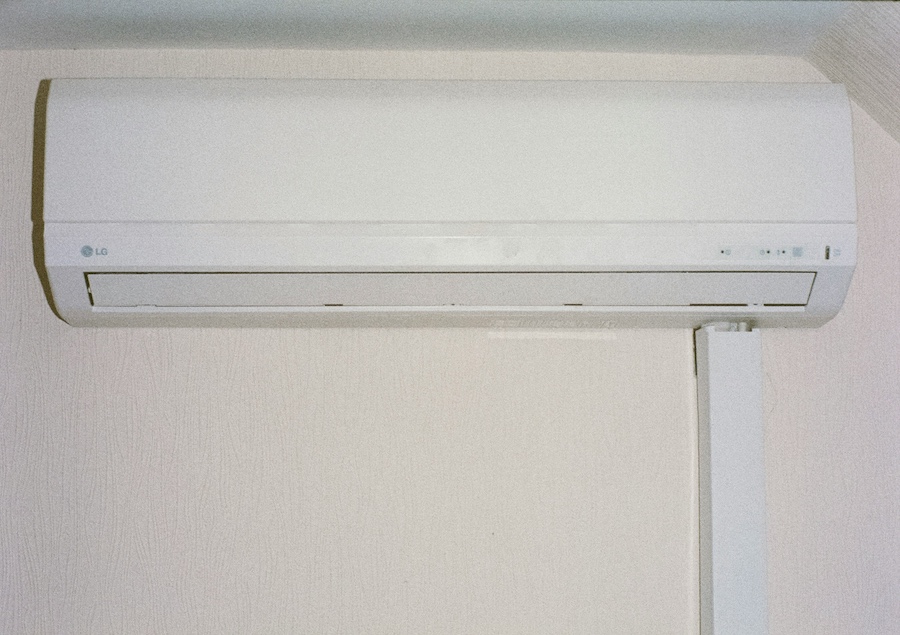
Top 9 Air Conditioners in Malaysia by Room Size
1. Midea 1.5HP Inverter, RM1,317
Fits: 150 to 250 sq ft master bedroom.
This is the value anchor of the Malaysian market and the reason is a single number: RM164. That is what Midea charges to move from its 1.5HP non-inverter at RM1,153 to the inverter at RM1,317, and it is the smallest inverter premium of any matched pair we found. At 8 hours a night it returns itself in four months.
Midea also runs the deepest discounting in the category, with Senheng listing a Glory 5 Star Pro inverter at 39% off in October 2026, so the RM1,317 figure is closer to a ceiling than a floor. Service reach is broad across Klang Valley, Penang and JB.
2. Midea 1.0HP Inverter, RM1,098
Fits: up to 150 sq ft second bedroom or study.
The same premium logic at the smaller size, though less emphatically: RM229 over the RM869 non-inverter, clearing in eight months at 8 hours a day. At 2 hours a day it takes 30 months, which is the one configuration in this list where we would not argue hard against the fixed-speed unit on economics alone, setting the 4.10 Floor aside.
3. Daikin 1.5HP Inverter, RM1,780
Fits: 150 to 250 sq ft bedroom where service life matters more than payback.
Daikin’s Malaysian prices sit RM463 above Midea at the same capacity, and you are not buying efficiency with that gap, you are buying the parts network. Daikin has manufactured in Malaysia for decades and its control boards are the ones independent technicians actually stock, which matters because a failed inverter PCB on an orphan brand is the repair that writes off the unit.
Published bands run RM1,900 to RM2,400 for Daikin 1.5HP inverter at other retailers, so RM1,780 is at the keen end.
4. Panasonic 1.5HP Inverter, RM1,929
Fits: 150 to 250 sq ft bedroom.
Strong local service and a well-regarded nanoe filtration option, at a premium we think is harder to justify on the numbers than Daikin’s. Panasonic charges RM530 to move off its own non-inverter, more than three times Midea’s step, and the efficiency you receive for that premium is the same efficiency.
If you want Panasonic, buy it for the build and the dealer, not because the inverter maths is better. It is worse.
5. Hisense 1.5HP Inverter, RM1,350 to RM1,600
Fits: 150 to 250 sq ft bedroom on a tight budget.
The closest challenger to Midea on price, with published bands overlapping it. We rank it below Midea only because we could not verify a matched non-inverter pair to calculate the premium, and because its service footprint in East Malaysia is thinner. Several Malaysian listings bundle free installation, which is worth RM280.
6. Haier 1.0HP Inverter, RM1,100 to RM1,300
Fits: up to 150 sq ft bedroom.
Priced within RM200 of Midea at the same size, and Haier has been visibly expanding its Malaysian presence through 2026. A reasonable second quote to collect rather than a first choice, and the band is wide enough that the specific model and the specific month matter more than the brand.
7. Midea 2.0HP Inverter, RM2,100 to RM2,500
Fits: 250 to 400 sq ft living and dining area.
The living hall workhorse. Note that 2.0HP crosses into the 4.5 to 7.1 kW MEPS category, where the 2026 2-star floor is CSPF 4.00 rather than 4.10 and the 5-star threshold is 5.60 rather than 6.09. The thresholds are slightly easier, so a 5-star 2.0HP is a genuinely different claim from a 5-star 1.5HP.
Midea’s own 2.0HP non-inverter sits at RM1,955, which makes the premium RM145 to RM545 depending on where in the band you land.
8. Daikin 2.0HP Inverter, RM2,999
Fits: 250 to 400 sq ft living hall, high ceiling or west facing.
The pick for the room that defeats cheaper units: a double volume living area, a top floor corner, or glass on the afternoon side. At 8 hours a day a 2.0HP saves RM60.80 a month over a fixed-speed equivalent, the largest absolute saving in this list, which is also why oversizing to 2.0HP for a bedroom is an expensive mistake rather than a safe one.
9. CUCKOO Vita-S Inverter, price not published
Fits: unclear from published material.
CUCKOO entered the Malaysian aircon market with the Vita-S inverter and promotes a 5-star rating in its own learning centre material. We could not retrieve an outright price, a horsepower lineup, or rental terms from any CUCKOO page, and its product pages were not accessible to us on 7 October 2026.
We are listing it last and without a recommendation for that reason. CUCKOO’s rental model works well in water and air treatment, where its 2,000 plus service staff handle the filter changes that owners skip, and an aircon rental bundling chemical washes would be a genuinely useful product in this market. We cannot tell you what it costs. Ask for the monthly figure, the contract length, and whether chemical servicing is included or billed separately.
A note on CUCKOO’s published savings figure, because it illustrates why we recalculate brand numbers. Its learning centre compares a 3-star unit at 3,840 kWh a year against a 5-star at 2,640 kWh and puts the saving at about RM600 a year. The kWh gap of 1,200 is plausible. The ringgit figure uses a round 50 sen per kWh, and at the actual 44.43 sen domestic rate the same gap is RM533 a year, not RM600.
Can you rent an air conditioner in Malaysia instead of buying?
Only from a short list. LG Subscribe starts at RM75 a month including installation and five years of servicing support, with ownership transferring at the end of the term. CUCKOO sells the Vita-S inverter but publishes no rental terms we could retrieve. Coway, Gintell and Ogawa do not sell air conditioners in Malaysia at all, so the rental comparison set that applies to water purifiers and massage chairs does not transfer to this category.
| Route | Monthly | Contract | Included | Ownership at end |
|---|---|---|---|---|
| LG Subscribe | From RM75 | Not published | Installation, five years servicing support | Transfers on full payment |
| CUCKOO Vita-S | Not published (MY) | Not published | Not published | Not published |
| Card instalment, 0% plans | Price divided by tenure | 6 to 36 months typical | Nothing beyond the unit | Immediate |
| Outright | Not applicable | Not applicable | Installation from RM250 | Immediate |
Routes available for a residential split-unit air conditioner in Malaysia, October 2026. LG figure is the promoted entry price after a stated RM5 monthly rebate. Source: LG Subscribe terms as reported in Malaysian consumer press, retrieved 7 October 2026. Contract length is not stated in any source we could retrieve, which is the single most important missing number in the comparison. Card instalment tenures from Malaysian issuer instalment-plan pages.
Run the arithmetic the brochure does not. A Midea 1.5HP inverter at RM1,317 plus RM280 installation is RM1,597 in hand. At RM75 a month the subscription passes that total in month 22. If the contract runs the five years its servicing promise implies, the subscription costs RM4,500, which is 2.8 times the outright route for the same cooling.
What you buy with the difference is the servicing, and that is not nothing. A chemical wash runs RM160 to RM350 and a conscientious owner books one or two a year per unit, so five years of covered servicing on a single unit is plausibly worth RM800 to RM3,500 depending on how diligent you would otherwise have been. The honest version is that subscription suits the household that will not book servicing and will not budget for a RM1,600 outlay, and the 0% card instalment beats it outright for anyone who will.
Key takeaway: before signing any aircon subscription, get the contract length in writing. A monthly figure without a term is not a price, and no source we checked publishes LG Subscribe’s.
What the quote and the running cost both leave out
Installation at RM250 for 1.0HP and RM280 for 1.5HP covers about 10 feet of copper. Beyond that, piping runs RM20 to RM35 a foot. Servicing adds RM50 to RM120 for a basic clean and RM160 to RM350 for a chemical wash, per indoor unit, and that cost is identical whether the compressor is fixed-speed or inverter.
Three line items account for most of the gap between what buyers budget and what they pay.
Copper is the first. Standard installation includes roughly 10 feet of refrigerant piping, and a condenser on a different wall or a floor below adds RM20 to RM35 per additional foot. A 25 foot run adds RM300 to RM525 to a RM280 install, which can exceed the entire inverter premium on a Midea. Our guide to what an aircon installation quote should include walks the itemisation line by line.
Servicing is the second, and it is the cost that does not care which compressor you chose. Basic service RM50 to RM120, chemical wash RM160 to RM350, chemical overhaul RM200 to RM350 and up, gas top-up RM80 to RM250 for units up to 2.5HP. Two indoor units serviced twice a year at the lower end is RM200 annually, which is a fifth of the running cost saving that the inverter upgrade delivers on a 1.5HP.
The inverter control board is the third, and it is the real argument against the cheapest brands. A fixed-speed unit’s failures are mechanical and generic. An inverter’s expensive failure is a board that is model-specific and sometimes unobtainable for brands that have exited the market. This is the one place where Daikin’s RM463 premium over Midea defends itself: an orphaned board turns a repairable eight year old unit into a replacement, and our guide on when aircon repair stops making sense sets out the ringgit threshold where that call flips.
Key takeaway: ask for the included piping length in feet before you compare two installation quotes. It is the line most often left blank and the one most often billed.
How to Pick the Right Air Conditioner in Malaysia
Six questions for the dealer, in the order they matter.
- What is the CSPF in Wh/Wh? Not the star count. A number you can check against the 2026 band.
- When was this model registered with Suruhanjaya Tenaga? This tells you whether the stars on the carton use the pre-2026 or post-2026 scale.
- How many feet of copper piping are included, and what is the rate beyond that? Get both numbers written on the quote.
- What is the price of the matched non-inverter in the same series? The difference is the premium. Run it against RM3.76 per horsepower per daily hour.
- Is the control board stocked locally, and for how many years after model discontinuation? The answer separates a 12 year unit from an 8 year one.
- For a subscription, what is the contract length and does it cover chemical washes or only basic service? A monthly figure alone is not comparable to a purchase price.
Red flag: a dealer who cannot produce the CSPF figure or the energy label for a unit they are selling as 5-star. The rating is a regulated registration, not a marketing claim, and a seller who does not have it to hand either does not know the stock or is selling against the old scale.
Work out your own numbers before you walk into a showroom
Measure the room in square feet, apply 51 and 66 BTU per square foot, and note whether the answers straddle a horsepower line. Then ask two dealers for the inverter and non-inverter price in the same series and divide the difference by RM3.76 times the horsepower times your daily hours. That is your payback in months, calculated on your room and your usage rather than a brochure’s.
If you want the wider picture on how big-ticket Malaysian appliances price out across ownership routes, our pillar guide on buying outright, renting or paying by instalment runs the same arithmetic across water purifiers, air treatment and large appliances.
Frequently Asked Questions About Air Conditioners in Malaysia
What is the 4.10 Floor?
The 4.10 Floor is the CSPF a room air conditioner under 4.5 kW must reach to be sold in Malaysia from 1 January 2026, when the 2-star minimum rose from CSPF 3.10. Published data puts fixed-speed non-inverter units at CSPF 3.4 to 3.5, roughly 17% short. For 2.0HP and 2.5HP units the equivalent floor is CSPF 4.00.
How much does a 1.5HP inverter aircon cost in Malaysia in 2026?
Verified prices run RM1,317 for Midea to RM1,929 for Panasonic, with Daikin at RM1,780 and Hisense from RM1,350. Installation adds RM280 including about 10 feet of copper. Budget RM1,600 to RM2,250 installed, and add RM20 to RM35 per foot for piping beyond the included length.
Does an inverter aircon need less servicing than a non-inverter?
No. Servicing cost and frequency are identical: RM50 to RM120 for a basic clean and RM160 to RM350 for a chemical wash, per indoor unit, for both compressor types. The difference appears only in repairs. An inverter’s control board is model-specific and expensive, while a fixed-speed unit’s failures are mechanical and generic.
Will my 5-star aircon still be 5-star next year?
Its CSPF does not change, but the band it falls in already has. A unit at CSPF 5.30 rated 5-star to 31 December 2025 sits at 3-star under the 2026 to 2029 schedule, and from 2030 the 2-star minimum rises to CSPF 6.09, above the old 5-star threshold. Nothing requires you to replace a running unit.
What aircon size do I need for a 250 square foot living room?
Malaysian guidance splits evenly at that figure: two published tables say 1.5HP and two say 2.0HP, a difference of roughly RM700. Take 1.5HP for a shaded interior room and 2.0HP for a west-facing wall, floor to ceiling glass, a top floor, or a ceiling above 10 feet.
Is it cheaper to run the aircon all night or switch it on and off?
For an inverter, continuous operation at a steady 24 to 25 degrees usually wins, because its efficiency advantage comes from modulating down to a low steady load and every restart runs the compressor at full draw. For a fixed-speed unit the calculation is closer, since it cannot modulate and cycles on and off regardless.


