
Key Takeaways
- Kuala Lumpur’s public transit network includes MRT, LRT, monorail, buses, and commuter rail serving most major areas
- The MRT and LRT are the fastest ways to travel between neighborhoods and suburbs, with fares typically RM1.20–RM4.50
- Grab provides door-to-door service when transit doesn’t reach your destination, though it costs 3–4 times more during peak hours
- A Touch ‘n Go card eliminates queues and works across nearly every transit mode
- Matching the right transport mode to your specific situation saves both time and money
Kuala Lumpur has trains, a monorail, rapid buses, highway buses, and ride-hailing apps, all running simultaneously and often overlapping in confusing ways. First-time visitors frequently overpay for taxis, wait too long for the wrong bus, or default to Grab for every journey when an MRT ride would complete the trip faster and cheaper.
This guide explains every major transportation option, what each one does best, and how to use it without second-guessing yourself.
Understanding Kuala Lumpur’s Public Transit Network
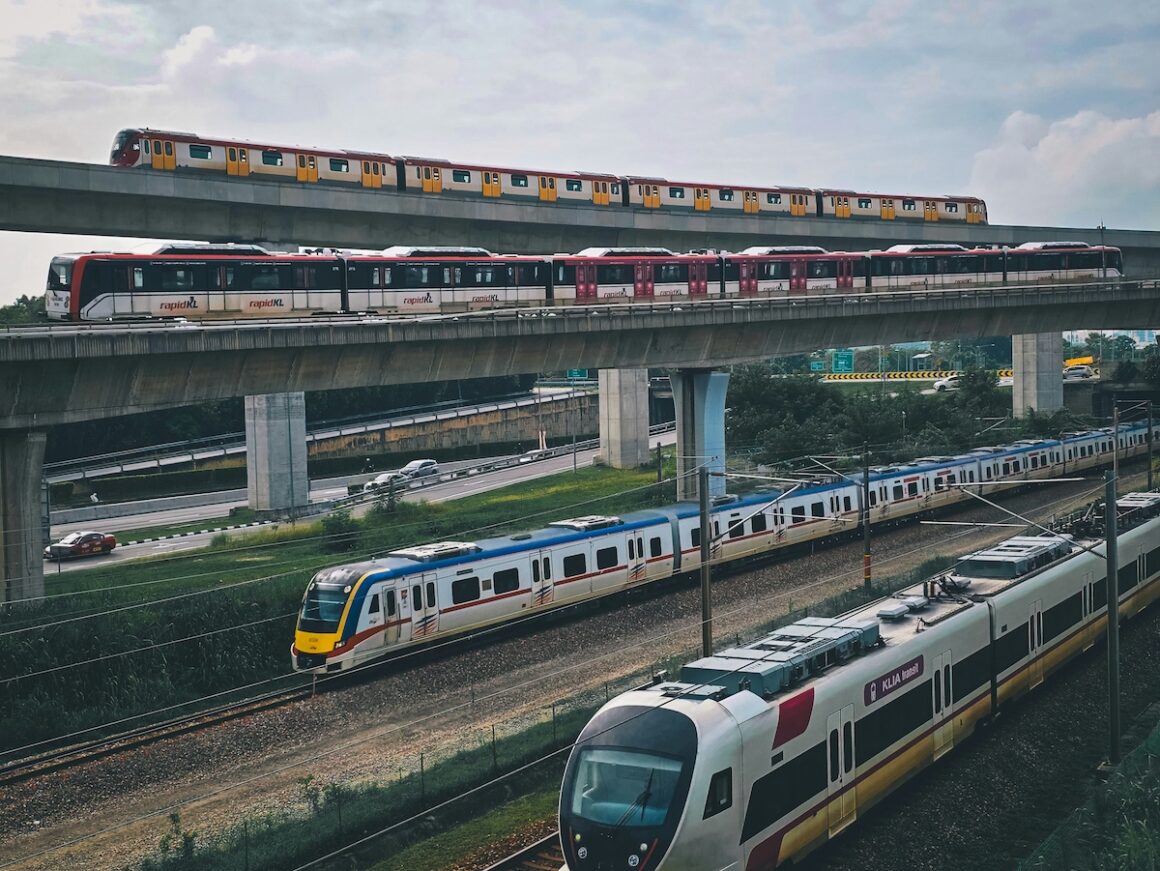
KL’s public transit system consists of several independently operated rail lines that connect at major interchange stations: the MRT (Mass Rapid Transit), LRT (Light Rail Transit), KTM Komuter, KL Monorail, and the BRT Sunway Line.
They are all integrated under the Rapid KL umbrella for fare payment, but were built at different times and serve different corridors. Some lines have paid zones and others unpaid zones, with transition points that can require you to exit and re-enter at certain interchanges. This matters most at Masjid Jamek, where the older lines and newer MRT don’t share a common paid area.
The three interchange hubs you’ll use repeatedly are KL Sentral, Masjid Jamek, and Bukit Bintang. Understanding where these sit on the map unlocks the connections you’ll need: KL Sentral serves the airport train, KTM Komuter, MRT, and LRT all in one station; Masjid Jamek connects the two oldest LRT lines; Bukit Bintang sits on both the MRT Kajang Line and the KL Monorail.
The Touch ‘n Go Card: Your Most Important Item
Almost every rail and bus system in KL accepts the Touch ‘n Go card, a prepaid contactless card you tap on entry and exit. Buy one at any train station customer service counter or at 7-Eleven. Load it with RM20 to start and top up as needed.
Using a Touch ‘n Go card instead of buying single-journey tokens saves you queue time and gives you slightly reduced fares on some lines. If you’re staying in KL for more than two days, get this card immediately upon arrival.
A Touch ‘n Go eWallet app functions as a digital version of the card and works on most trains and buses. Use it if you prefer not to manage a physical card, though the app requires active data connection while the physical card does not. If your connection drops or you run out of data, the physical card is a backup.
The MRT: The Fastest Way Across the City
The MRT Putrajaya Line and Kajang Line form the core of modern transit in Kuala Lumpur. These newer, air-conditioned trains have extensive coverage across the city and into surrounding suburbs. The Kajang Line runs from Kwasa Damansara in the northwest through central KL to Kajang in the southeast. The Putrajaya Line extends south toward Putrajaya and Cyberjaya.
For most visitors, the MRT connects key neighborhoods: Bangsar South, Bukit Bintang, Pavilion KL (via Bukit Bintang station), KLCC (via interchange to LRT), Chow Kit, and Kepong.
Trains run every four to six minutes during peak hours with reliable air conditioning. Fares are calculated by distance, typically between RM1.20 and RM4.50 for city journeys.
Best for: Covering medium to long distances across the city, reaching shopping malls and major landmarks, commuting between neighborhoods without traffic delays.
Limitations: The MRT does not cover every part of KL. Some neighborhoods and specific street-level destinations require a short walk or connecting bus from the nearest station.
The LRT: Covering the City’s Older Corridors
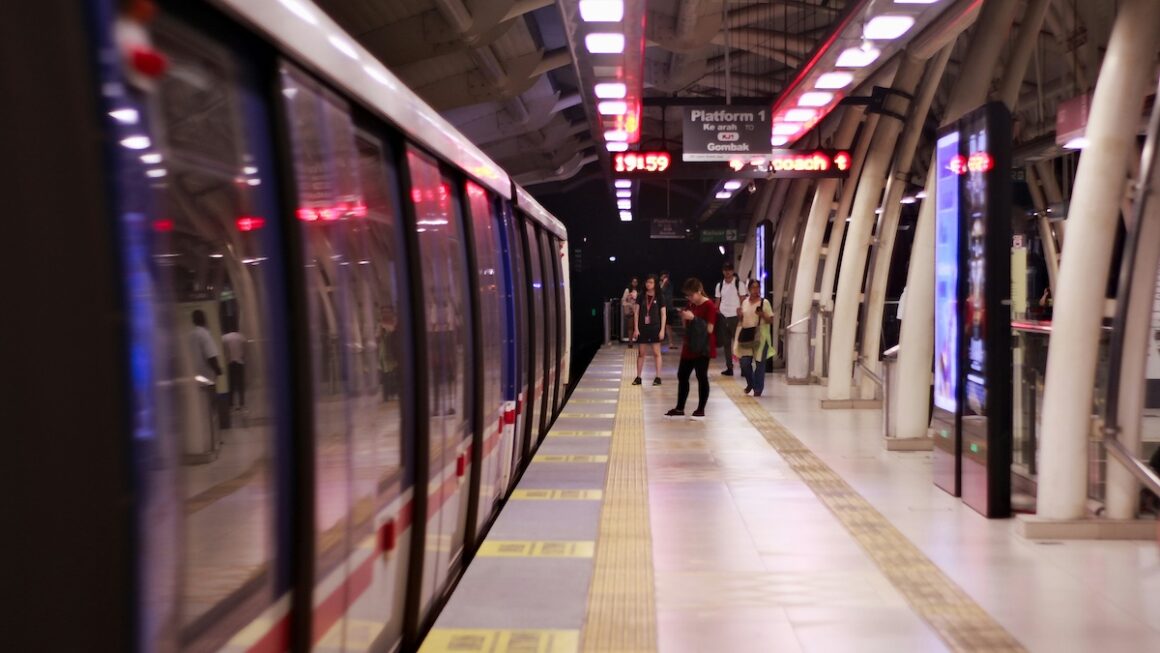
The LRT system has two main lines: the Ampang Line and the Kelana Jaya Line. Built earlier than the MRT, they cover corridors the newer system does not, particularly in eastern KL, Ampang, Petaling Jaya, and the Subang area.
The Kelana Jaya Line is most useful for travelers heading to Sunway. It connects KL Sentral to KLCC, then continues toward Subang and Sunway. Take it to Asia Jaya or Taman Jaya station, then connect to the free BRT Sunway shuttle to reach Sunway Lagoon or Sunway Pyramid shopping mall.
The Ampang Line serves eastern suburbs and specific destinations like Ampang Park and Sri Petaling, though most visitors won’t need it.
Best for: Reaching Petaling Jaya, Subang, and eastern KL where the MRT does not run, accessing Sunway destinations.
Limitations: Some sections feel older and become crowded during peak hours. Frequency is slightly less consistent than the MRT.
KL Monorail: The City Centre Connector
The KL Monorail is an 11-station line through the commercial center of the city, connecting KL Sentral in the south to Titiwangsa in the north. It passes through Brickfields, Imbi, Bukit Bintang, and Chow Kit.
For visitors staying in the Bukit Bintang or Golden Triangle area, the monorail is often the fastest way to reach KL Sentral for airport trains or connections to other lines. The Bukit Bintang station sits directly on Jalan Bukit Bintang, accessible from the main shopping strip.
The monorail gets crowded during peak hours, and trains are smaller than the MRT or LRT, so expect tighter conditions during rush times.
Best for: Short trips through the city centre, moving between Bukit Bintang and KL Sentral.
Limitations: Limited coverage beyond the central corridor. Not suitable for reaching suburban areas.
Rapid KL Buses: Affordable but Requires Planning
The Rapid KL bus network covers areas that trains cannot reach, including smaller streets, residential neighborhoods, and locations between stations. Hundreds of routes cross the city.
The Go KL City Bus is a free service circulating through four color-coded routes within the city centre, stopping at Bukit Bintang, KLCC, Masjid India, Chinatown (Petaling Street), and other central spots. For budget travelers, this is a genuine option for exploring the core tourist areas.
For routes outside the free zone, Rapid KL buses accept Touch ‘n Go and fares are very low, typically under RM2 for most journeys.
The main challenge is traffic. During peak hours, bus journey times lengthen significantly because buses share roads with private vehicles. Real-time tracking through the MyRapid or Moovit apps shows whether the bus is running late before you’ve left your hotel.
Best for: Reaching areas not served by rail, exploring the city centre using the free Go KL service.
Limitations: Slower than rail during peak hours, route planning takes more effort, not ideal for time-sensitive journeys.
KTM Komuter: For Outskirts and Day Trips
The KTM Komuter is a commuter rail service operated by Keretapi Tanah Melayu, Malaysia’s national rail operator. It covers longer-distance routes between KL and surrounding towns: Seremban, Rawang, Klang, and Batu Caves.
For travelers, the most common use is reaching Batu Caves, one of KL’s most visited attractions. The Batu Caves station is one stop north of KL Sentral on the Batu Caves branch line, with inexpensive tickets.
For day trips to towns within Selangor or Negeri Sembilan, KTM Komuter provides direct, low-cost rail access without hiring a car or booking a tour.
Best for: Batu Caves, Klang (for Bak Kut Teh), Seremban, and other surrounding towns accessible by rail.
Limitations: Trains run every 15 to 30 minutes, less frequently than the MRT or LRT. Arrival times are less predictable than other systems.
Grab: The Reliable Door-to-Door Option
Grab is the dominant ride-hailing app across Southeast Asia and covers all of Kuala Lumpur. For visitors who prefer not to navigate transit systems or when your destination is far from a station, Grab is the most practical alternative.
The app works like Uber. Enter your destination, see an upfront fare estimate, and a driver is matched to you within minutes. Most journeys within the city centre cost RM8 to RM20, though this rises significantly during peak hours (7:30–9:30am and 5–7:30pm weekdays), heavy rain, or major events.
Grab offers GrabCar (standard sedan), GrabCar Plus (better-rated vehicles), GrabTaxi (metered taxis via the app), and GrabFood delivery. Most visitors use standard GrabCar.
Grab pricing surges during rush hour. If your route has a direct MRT or LRT option, the comparison is worth 30 seconds: the train will likely cost one-quarter to one-third of the Grab fare during those windows.
Best for: Destinations not near transit stations, late-night travel, carrying luggage, groups where per-person cost equals transit fare.
Limitations: Surge pricing during peak hours, traffic delays in the city centre during rush hour. Pickup zones near major malls like Suria KLCC and Pavilion KL can be unclear, requiring you to walk several minutes to find your driver.
Taxis: Still Around but Use Wisely
Traditional metered taxis still operate in KL but with inconsistent service. Some drivers refuse to use meters, preferring to negotiate flat rates that are almost always higher than Grab or metered fares. Budget Taxi, Comfort Cab, and MyCar are more reputable companies.
If you use a traditional taxi, insist on the meter from the start. If the driver refuses, booking a Grab is usually more straightforward.
For airport transfers, Grab is more transparent on pricing than the taxi counters inside KLIA. The fixed counter rates often exceed typical Grab fares to the same destination.
Best for: Situations where Grab is unavailable or you cannot connect to mobile data.
Limitations: Inconsistent meter use, negotiated fares are rarely competitive, harder to dispute charges compared to app-based rides.
The KLIA Ekspres: Getting to and from the Airport
The KLIA Ekspres is the fastest and most reliable airport connection. The train runs between KLIA and KL Sentral in around 28 minutes, with departures every 15 to 20 minutes.
Adult fares are approximately RM55 one way. This is more expensive than Grab, but the trade-off is bypassing toll road traffic between KL and the airport, which during peak hours or bad weather can add 30 to 60 minutes to any road journey.
For KLIA2 (the terminal used by AirAsia), a separate service stops at both KLIA and KLIA2, adding around 3 minutes to the journey. Both use the same track and require the same ticket.
Best for: On-time arrivals and departures, avoiding traffic unpredictability.
Limitations: Higher cost compared to road transfers, runs from KL Sentral only. You’ll need a connecting train or Grab to reach your final destination if it’s not near KL Sentral.
How to Choose the Right Option
| Situation | Recommended Option |
| Crossing the city quickly | MRT or LRT |
| Bukit Bintang to KL Sentral | KL Monorail |
| Free city centre sightseeing loop | Go KL City Bus |
| Getting to Batu Caves | KTM Komuter |
| Destination not near a station | Grab |
| Airport transfer, speed priority | KLIA Ekspres |
| Airport transfer, cost priority | Grab |
| Group travel with luggage | Grab |
Frequently Asked Questions
Is Grab or public transport cheaper in Kuala Lumpur? Public transport is almost always cheaper. An MRT ride across the city costs under RM4, while the same journey by Grab costs RM12 to RM20 or more during peak hours. The trade-off is door-to-door convenience versus a short walk at each end of the train journey.
Do I need a SIM card to use Grab in KL? Yes, Grab requires an active internet connection. Most visitors pick up a tourist SIM card at the airport on arrival, typically RM15 to RM30 for several days of data. Portable Wi-Fi rentals are also available at major airports.
Can I use contactless credit or debit cards on KL trains? Some stations now accept Mastercard and Visa contactless payment at fare gates, but coverage is not consistent across all lines and stations. The most reliable approach is a Touch ‘n Go card or eWallet. Do not assume your foreign bank card will work at every gate.
What is the best transport option for getting from KLCC to Bukit Bintang? The two neighborhoods are within walking distance, around 10 to 15 minutes on foot through the Bukit Bintang Pedestrian Walkway, which is shaded and covered in parts. Alternatively, the free Go KL City Bus connects both areas. Taking Grab for this journey is rarely worth the fare.
Is it safe to travel by public transport in Kuala Lumpur at night? KL’s rail network generally operates until around midnight on most lines. Trains and stations are well-lit and reasonably busy throughout the evening. Late-night bus travel is less advisable due to reduced frequency rather than safety concerns. Grab is the practical option for travel after midnight.
How far in advance should I book a Grab for the airport? Book at least 30 to 45 minutes before departure during peak hours. Surge pricing and driver availability are unpredictable during morning rush and late afternoon. If your departure is time-critical, the KLIA Ekspres from KL Sentral eliminates this uncertainty.
Once you understand which network covers which part of the city and carry a Touch ‘n Go card, navigating Kuala Lumpur becomes straightforward. The system is designed for tourists: stations have English signage, apps work reliably, and fares are transparent. Your only real decision is choosing speed over cost or cost over speed, and this guide gives you the numbers to make that call.


