
- Target 45% to 55% relative humidity. Above 65%, paper storage risks mould. Below 30%, card stock turns brittle. Kuala Lumpur’s air averaged 78.1% across 2018 at the Subang weather station.
- What it costs: a 6-litre dry box with a built-in hygrometer is RM130.55. An Ailite 30L electronic dry cabinet is RM279 and costs at most about RM4.80 a month in electricity. A room dehumidifier starts around RM1,499 for a 22L Xiaomi.
- The 7 steps: measure your room, sleeve and toploader, pick a storage tier, set the cabinet to 45% to 55%, keep sealed boxes and slabs in the band, respect the Dew Line when moving cards, and maintain your desiccant.
- The Dew Line: on a 30°C KL afternoon, anything cooler than about 25.8°C gathers condensation the moment it meets outside air. Cards out of an aircon room are always below it.
A curled holo is the first sign. Leave a Pokémon binder in a non-aircon room in Kuala Lumpur and the foil cards start to bow within weeks, because the air there sits 13 percentage points above the 65% line where paper storage starts to risk mould.
What you’ll need before starting
A hygrometer, sleeves and toploaders, and one sealed storage option matched to your collection: a dry box from RM130.55, a dry cabinet from RM229, or a room dehumidifier from around RM1,499. Calcium chloride moisture absorbers (RM21.17 for three at Watsons) help in the cupboard around your storage, not inside it.
Table 1. Humidity control options for trading cards in Malaysia, with October 2026 RM prices.
| Option | Example product | Price (RM) | Holds humidity at a set level? | Best for |
|---|---|---|---|---|
| Moisture absorber tubs | Thirsty Hippo 600ml, pack of 3 | 21.17 (promo; list 25.90) | No | Cupboards and wardrobes around your storage |
| Dry box with hygrometer and desiccant | Samurai Dry Box F-380, 6L | 130.55 | Only while the desiccant lasts | A deck, a binder or a few slabs |
| Electronic dry cabinet, 20L | Ailite ALT-20L | 229.00 | Yes | A small collection or a slab shelf |
| Electronic dry cabinet, 30L | Ailite ALT-30L | 279.00 | Yes | Several binders, deck boxes and slabs |
| Electronic dry cabinet, 40L | Ailite ALT-40L | 373.00 | Yes | A large binder collection plus sealed product |
| Electronic dry cabinet, 60L | Ailite GP2-60L | 799.00 | Yes | Sealed booster boxes and Elite Trainer Boxes |
| Room dehumidifier, 22L/day | Xiaomi Mijia Smart Dehumidifier | 1,499.00 | Room-level | A dedicated card room or display cabinet wall |
You’ll also need sleeves and toploaders. We haven’t quoted RM prices for them because we couldn’t find a Malaysian retailer page that shows current prices. Buy them from the game store you play at.
There’s no rental or instalment option here. CUCKOO and Coway rent water and air purifiers in Malaysia, but neither lists a dehumidifier or dry cabinet plan, so the comparison this site runs on appliance guides doesn’t apply.
Why humidity damages cards
Quick answer: Three reasons. Paper swells faster than foil, so foil cards curl. Paper stored above 65% relative humidity risks mould. And cold cards brought into warm, humid air collect condensation. The first two happen slowly in a Malaysian room; the third happens in seconds.
Curling. A modern holo card is a paper core with a foil or printed layer on top. When the air is humid, the paper takes up moisture and swells faster than the foil, so the card bows. In very dry air, it curls the other way. Pokéfolio’s February 2026 card-care guide calls this the “Pringle effect” and says it hits holo, reverse holo and full-art cards hardest.
Mould. The Georgia Archives storage guide recommends 30% to 50% relative humidity for mixed collections including paper, give or take 5%, and warns that anything above 65% suits mould. KL’s 78.1% average sits well above that line.
Condensation. Air can only hold so much water at a given temperature. Cool it below its dew point and the water comes out as droplets on whatever’s cold. That’s why a sealed box carried out of an aircon room fogs up the moment you open it outdoors. It’s also the reason for the Dew Line, covered in Step 6.
The 45% to 55% band comes from the overlap of three sources: the Georgia Archives range plus its tolerance (up to 55%), Pokéfolio’s card-specific 35% to 55%, and the University of Connecticut Library’s 45% to 65% for general collections. Below 30%, Pokéfolio warns of brittleness, so going drier isn’t safer.
Step 1: Measure your room for seven days
Put a hygrometer where the cards live and note the reading morning and night for a week. If the room stays between 45% and 55%, sleeves and a closed box are enough. If it goes above 60%, you need a dry box or cabinet.
Most dry boxes and every digital Ailite cabinet come with a hygrometer, so you can measure with the product you’ll end up using anyway. Take readings in two places: the room where the cards are, and inside the closed storage box.
Readings change with the aircon. A bedroom that sits in the band while the aircon runs can drift back towards the outdoor 78% once it switches off. The night reading after the aircon is off is the one that matters.
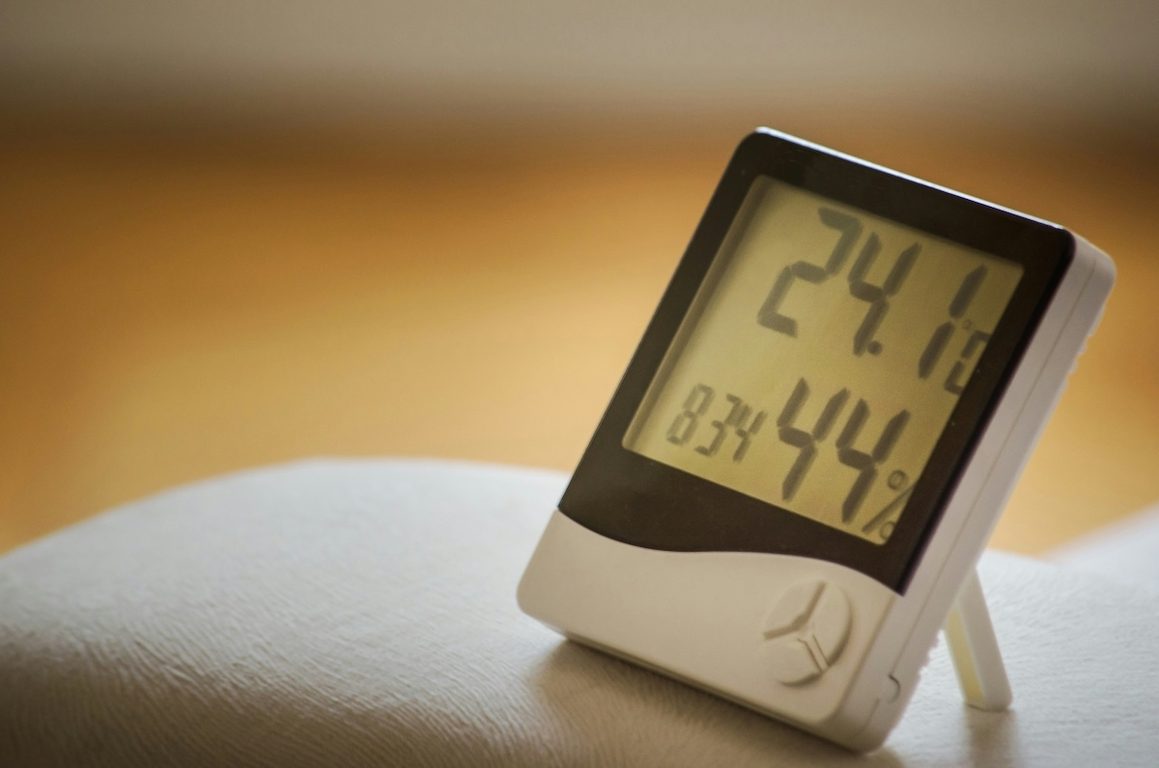
Key takeaway: a store room, kitchen-side cabinet or anything on an outside wall is the worst place to keep cards. Measure before you decide.
Step 2: Sleeve, then toploader the cards that matter
Every card you keep goes in a sleeve. Cards worth more than a few ringgit go in a sleeve plus a toploader or magnetic holder. A sleeve slows moisture and stops scratches; a rigid holder stops a slightly curled card from setting permanently in that shape.
Use sleeves and toploaders labelled acid-free and PVC-free. Binders should be side-loading, so the opening of each pocket faces sideways rather than up.
A sleeve doesn’t stop humidity. It slows the rate at which a card responds to it. Without Steps 3 to 5, a sleeved card in a 78% room still curls; it just takes longer.
Step 3: Pick a storage tier by what the collection is worth
Bulk and playsets: a closed box in an aircon room. A binder or a deck you care about: a 6L dry box at RM130.55. Chase cards, slabs or sealed product: an electronic dry cabinet, RM229 to RM373 for 20L to 40L. A whole room of stock: a dehumidifier.
The cabinet price makes more sense against what it protects. An Ailite ALT-30L at RM279 is 55.8% of the value of a single RM500 card, and 14% of a RM2,000 slab. If one warped card would cost you more than the cabinet, buy the cabinet.
A dry box and a dry cabinet aren’t the same thing. A dry box is a sealed plastic tub with a desiccant pack: it works until the desiccant is full, then stops. An electronic dry cabinet pulls moisture out continuously and holds the setting you choose. In a 78% climate, a dry box needs attention every few weeks.
Key takeaway: if you’re opening the box more than once a week, the desiccant fills faster. Go straight to a cabinet.
Step 4: Set the cabinet to 45% to 55%, not lower
Set the dial or digital control between 45% and 55% and leave it. Camera owners often run dry cabinets at 40% or below. That’s fine for lenses but sits too close to the 30% brittleness line for card stock.
The cabinets are built for cameras, where low humidity stops fungus on lenses. Cards need a narrower, wetter band than glass does. If your cabinet uses an analogue dial, check the built-in hygrometer after 24 hours and adjust.
Running cost is small. The Ailite ALT-30L is rated at 5V and 3A, which is 15 watts at most. Running at that ceiling all day for a month uses 10.8 kWh: about RM4.80 a month, or RM57.58 a year, at TNB’s domestic energy, capacity and network charges for households under 1,500 kWh. Real use is lower because the dehumidifier element cycles on and off.
Step 5: Keep sealed product and slabs in the band too
Shrink-wrapped booster boxes and graded slabs still respond to humidity over months. Sealed product sells at a premium for crisp, flat wrapping, and a warped box loses that premium even if the cards inside are fine. A 60L cabinet, RM799 for the Ailite GP2-60L, fits several booster boxes.
Store sealed boxes upright in the cabinet, away from the door seal. Graded slabs protect cards from handling. Don’t rely on them to stop moisture. Keep slabs in the same 45% to 55% band as your raw cards.
If you’re importing sealed product or slabs, our guide to import tax on trading cards in Malaysia covers what lands on top of the price. A box that warps in a store room after you’ve paid 33.1% in duty and taxes is an expensive mistake.
Step 6: Respect the Dew Line when you move cards
In KL’s average 78.1% humidity, the dew point is about 23.8°C on a 28°C day and 25.8°C on a 30°C afternoon. Any card, box or slab cooler than that will collect condensation the moment it meets outdoor air. We call this the Dew Line. Cards from a 24°C aircon room are always below it.
Table 2. Dew points for Kuala Lumpur air at the 2018 average relative humidity.
| Outdoor air temperature | Relative humidity | Dew point |
|---|---|---|
| 28°C | 78.1% | 23.8°C |
| 30°C | 78.1% | 25.8°C |
| 32°C | 78.1% | 27.7°C |
The Dew Line is why convention trips go wrong. You pack slabs in an aircon bedroom, carry them through a car park at 32°C and open the case. The slabs are at maybe 24°C; the air’s dew point is 27.7°C. Moisture forms on and inside anything cold.
The fix: carry cards in a sealed zip bag or closed deck box, and don’t open it until it has sat at the new room’s temperature for a while. Then the bag fogs, not the cards. The same applies in reverse when you bring cards home from a hot car into aircon, though the risk is lower because aircon air is drier: a 24°C room at 55% has a dew point of 14.4°C.
If you’re heading to a show, our list of TCG events in Malaysia covers the main conventions.
Step 7: Maintain your desiccant and absorbers
Check dry box desiccant every two to four weeks in a Malaysian room and recharge or replace it when the indicator changes colour. Replace calcium chloride absorbers like Thirsty Hippo (about RM7.06 a tub on promotion) when the liquid reaches the red mark. Never put calcium chloride tubs inside a card box.
Calcium chloride absorbers turn the moisture they pull into liquid brine. That’s fine on a wardrobe shelf and a disaster if the tub tips inside a box of cards. Use them in the cupboard around your dry box, and use silica gel or the supplied desiccant inside it.
Reusable silica gel packs change colour when they’re full. Follow the maker’s instructions for drying them out, and keep a spare set so the box isn’t left without protection while one set recharges.
How do you know it’s working?
The hygrometer inside your storage holds between 45% and 55%, and stays there overnight. Holo cards lie flat in their sleeves, and nothing smells musty when you open the box.
Table 3. What to check, how often, and what it means.
| Check | How often | Good result | Act if |
|---|---|---|---|
| Hygrometer inside storage | Weekly | 45% to 55% | Above 60% or below 35% |
| Holo and full-art cards | Monthly | Flat in sleeve | Visible bow |
| Desiccant indicator (dry box) | Every 2 to 4 weeks | Original colour | Colour changed |
| Smell on opening | Each time | Neutral | Musty or sour |
| Sealed box wrapping | Monthly | Tight, flat | Wavy or loose |
Troubleshooting
My holo cards are already curled. Put them in the 45% to 55% band and wait. Pokéfolio’s guide says curled cards often flatten on their own within weeks once the humidity is stable. Don’t use heat, a hairdryer or the microwave; they damage card stock permanently.
The cabinet won’t go below 60%. Check the door seal and how often it’s opened. In a non-aircon room in KL, a small cabinet works harder; move it into an aircon room if you can.
I can see white or grey spots. That could be mould. Isolate the card from the rest of the collection, put it in a fresh sleeve and get it looked at by someone who handles damaged cards before you store it with anything else.
A slab fogged up after a show. That’s the Dew Line. Leave it closed at room temperature until it clears. Store slabs in the band afterwards.
The power went out. A sealed dry cabinet with its door shut drifts slowly. Leave it shut until the power is back and check the hygrometer after it’s been running for a day.
When a dry cabinet isn’t worth it
If your collection is bulk commons and a few playsets, and your bedroom hygrometer stays under 60% overnight, a closed box and sleeves are enough. Spending RM279 to protect cards worth RM2 each doesn’t add up.
If you’re keeping cards in a room that’s 75% or more most nights, though, a dry box is the minimum. And if you’ve got more sealed product than will fit in a 60L cabinet, look at a room dehumidifier instead; our guide to the best dehumidifiers in Malaysia compares models by litres per day and running cost. An inverter air conditioner running in the card room is the other option, and it does the job while you’re using the room anyway.
For the bigger picture on what each game costs to collect and play, see our guide to the popular trading card games in Malaysia.
Frequently asked questions
What humidity should trading cards be stored at?
45% to 55% relative humidity. That’s the overlap of archival guidance for paper (30% to 50%, plus or minus 5%) and card-specific advice (35% to 55%). Above 65%, paper storage risks mould. Below 30%, card stock can turn brittle. Measure inside the storage box, not just the room.
Is a dry cabinet worth it for Pokémon cards?
Yes, for anything valuable. An Ailite ALT-30L costs RM279 at Camera2U and holds a set humidity continuously, unlike a dry box that relies on desiccant. That’s under 15% of a single RM2,000 slab. For bulk commons in an aircon room, sleeves and a closed box are enough.
Can I use Thirsty Hippo or calcium chloride absorbers for cards?
Only outside the card box. Calcium chloride absorbers like Thirsty Hippo turn moisture into liquid brine, which ruins cards if a tub leaks or tips. Put them in the wardrobe or cupboard where you keep your dry box. Use silica gel or the supplied desiccant inside the box itself.
How much electricity does a dry cabinet use?
Very little. The Ailite ALT-30L is rated at 5V and 3A, at most 15 watts. Running at that ceiling 24 hours a day uses 10.8 kWh a month, about RM4.80 at TNB’s domestic rates for households under 1,500 kWh. Actual use is lower because the drying element cycles.
Why do my cards sweat after I bring them outside?
Condensation. Cards from a 24°C aircon room are colder than the dew point of KL’s outdoor air, which is about 25.8°C at 30°C and 78% humidity. Water condenses on anything cooler than the dew point. Carry cards in a sealed bag and let it warm up before opening.
Should graded slabs go in a dry cabinet too?
Yes. A slab protects a card from handling and dust. It isn’t sold as a moisture barrier. Keep slabs in the same 45% to 55% band as raw cards, store them upright, and don’t open a cold slab case in hot, humid air, for example when you arrive at a show.


