
Checking a yoga school takes about 10 minutes and costs nothing. Six steps: get the school’s exact registered name, find it in the Yoga Alliance directory, confirm the designation matches the course you are buying, check the lead trainer, read the trainee reviews, and inspect a sample certificate.
The step most buyers skip is the lead trainer. Yoga Alliance requires the lead trainer of a 200-hour school to hold an E-RYT 500 credential and to teach 150 of the 200 hours in person or live. So ask every school one thing: who teaches 150 of my 200 hours, and can I see their profile? We call this the 150-Hour Question. A school that cannot name that person has a gap between what it sells and what it registered.
If the school fails the check, you cannot register as an RYT 200 through the standard route, however good the teaching was.
Yoga Alliance has accepted no standard RYT applications from graduates of non-registered schools since 31 August 2011. In KL, where 200-hour courses cost RM5,600 to RM8,300, that makes a 10-minute check the cheapest insurance in the whole purchase.
What you need before starting
- The school’s name in English characters. Yoga Alliance directory names must use English characters only, so a school that trades under a Chinese or Malay name with diacritics will be listed under its English name.
- The exact course you are being sold: 200-hour, 300-hour, 500-hour, children’s or prenatal.
- The lead trainer’s full name, from the school’s brochure or by asking.
- A sample certificate, or a photo of a past graduate’s certificate with the name covered.
- A browser. No account is needed to search the directory.
Time: 10 minutes per school. Allow a day for the school to reply to the lead trainer question.
Why a registry check works, and where it stops working
Quick Answer: Yoga Alliance is a US nonprofit registered as a 501(c)(6) trade association. It is not a Malaysian regulator and does not accredit or licence anyone. A school’s RYS credential exists only while the school keeps paying: US$640 (about RM2,596) in its first year and US$240 (about RM974) every year after, per credential.
That payment model is why you check the directory and not the school’s website. A website badge is a one-off image. The directory listing reflects the school’s current membership, and the RYT application form makes you search for and select your school from that same register. Your school then has up to 14 days to confirm you completed the training. If the school is not an active RYS, there is nothing to select and nobody to confirm.
The check has two limits. Registration tells you a school submitted a curriculum that met Yoga Alliance’s hour standards; it does not inspect classes. And Yoga Alliance’s published guide does not say what happens to your application if a school lapses between your enrolment and your graduation. That is why step 6 below is a re-check, not a one-off.
Table 1: Yoga Alliance school credentials and what each lets a graduate register as.
| School credential | Course hours | Lead trainer must hold | Hours taught by lead trainer | Min. live (synchronous) hours | Graduate registers as |
|---|---|---|---|---|---|
| RYS 200 | 200 | E-RYT 500 | 150 | 30 | RYT 200 |
| RYS 300 | 300 | E-RYT 500 | 135 to 300 | 45 | RYT 500 (with a prior RYS 200) |
| RYS 500 | 500 | E-RYT 500 | 200 | 75 | RYT 500 |
| RCYS (children’s) | 95 | E-RYT and RCYT | 37 | 14 | RCYT |
| RPYS (prenatal) | 85 | E-RYT and RPYT | 36 | 13 | RPYT |
Step 1: Get the school’s registered name and designation in writing
Ask the school for two things by email or WhatsApp: the exact name it is registered under with Yoga Alliance, and its designation (RYS 200, RYS 300, RYS 500, RCYS or RPYS). A registered school answers in one line.
Studios often trade under a different name from their registered one, and a chain may register one school entity for several branches. Yoga Alliance requires the certificate to carry the RYS’s registered name, with any branch name added alongside rather than replacing it. So the registered name is the string you will search, and the one that must appear on your certificate.
Done looks like: a written reply with a name and a designation. Common mistake: accepting “we are Yoga Alliance certified.” Yoga Alliance registers schools; the word “certified” in a school’s marketing tells you nothing about which register, or whether it is current.
Step 2: Search the Yoga Alliance directory
Go to yogaalliance.org, open the directory, switch to Find a yoga school, and search the registered name from step 1. If nothing comes up, try the city (Kuala Lumpur, Petaling Jaya) and scan the results.
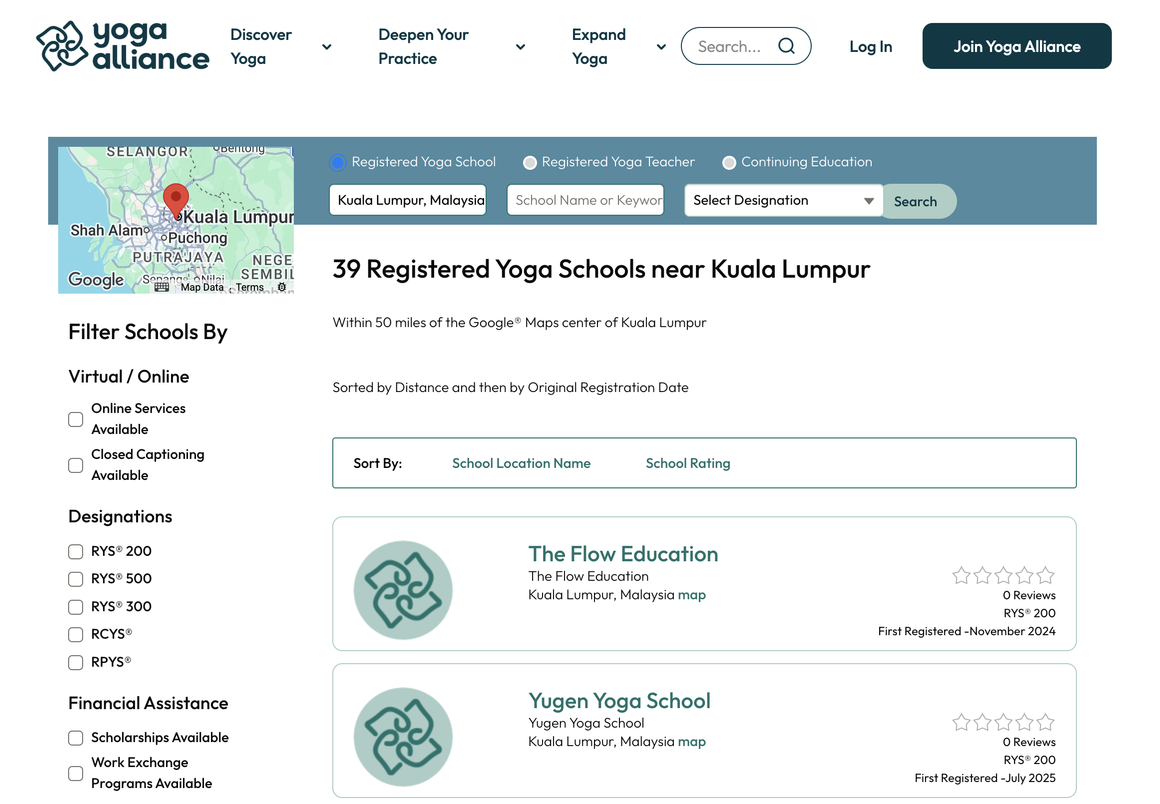
Done looks like: a school profile page showing the school name, location and at least one RYS designation. Common mistake: finding a teacher profile and taking it as the school’s. An individual can be an RYT 200 or even an E-RYT 500 while the course they run is not registered at all. A teacher’s credential is personal. It does not transfer to a course they sell.
Step 3: Match the designation to the course you are buying
The designation on the profile must match the course. A 200-hour course needs RYS 200. A school holding only RYS 300 cannot register a beginner’s 200-hour course, and an RCYS (children’s) listing says nothing about its adult training.
Each credential is registered and paid for separately, so a school can legitimately hold one and not another. This matters most for schools that run several courses. A Bangsar studio could hold RYS 200 for its foundation course and still sell a 300-hour advanced course that is not registered.
Check the format too. A registered 200-hour course can be fully online, but Yoga Alliance requires at least 30 of the 200 hours to be live, with teacher and students together in real time. A self-paced recorded option, which some KL schools offer as a make-up route, still sits inside that rule. Ask how many of your hours will be live.
Done looks like: the profile lists the exact designation you need.
Step 4: Ask the 150-Hour Question
Ask who teaches 150 of your 200 hours, then search that person in the teacher directory. Their profile should show E-RYT 500, the credential Yoga Alliance requires of every RYS 200 lead trainer.
An E-RYT 500 has logged at least 2,000 teaching hours over at least four years since their training. That is the person a registered school has promised will teach three quarters of your course. If the school instead names a guest teacher for one weekend and an assistant for the rest, you have found the gap between the brochure and the registration.
Teacher profiles state the credential in a single line, for example “is a E-RYT 500 with Yoga Alliance, which acknowledges the completion of a yoga teacher training with a Registered Yoga School (RYS).”
Done looks like: a named lead trainer whose public profile shows E-RYT 500. Common mistake: accepting a lead trainer’s credential from another country’s register. Yoga Alliance Professionals, a UK body, states it is “not related or connected in any way with any other Yoga Alliance.” Its credentials are real, but they are not Yoga Alliance (US) credentials.
Step 5: Read the trainee reviews
Open the school’s reviews tab. Every graduate must review their training to complete RYT registration, reviews are attributed rather than anonymous, and the rating shows as 1 to 5 stars converted from a Net Promoter Score.
The catch: the school chooses whether to publish them. Yoga Alliance’s social credentialing page states that reviews appear on a school’s public profile only “if a RYS chooses to publish trainee responses.” So an empty reviews tab on a school with years of graduates is a question worth asking, not proof of anything. A new school will have none.
Done looks like: published reviews you have read, or a school’s answer on why they are hidden.
Step 6: Inspect a sample certificate, then re-check before you pay the balance
A certificate Yoga Alliance will accept carries five things: the RYS’s registered name in English, the track (for example 200-hour), the completion date to the day, the trainee’s legal name in English, and a handwritten signature from someone at the school other than the trainee.
Ask for a redacted past certificate. If the name on it differs from the directory listing, or it says “Yoga Alliance certified” with no track or date, the school will struggle to get your application confirmed.
Then re-run step 2 on two dates: before you pay any balance, and before your final module. Membership is annual. A school that lapses mid-course is a risk the published guidance does not cover, so get the school’s answer in writing on what happens if it does.
Done looks like: a certificate sample with all five fields, and two dated screenshots of the directory listing.
For KL schools specifically, our comparison of yoga teacher training in KL with RM costs shows which schools have published fees and where each stood on this check.
What a pass and a fail look like
Table 2: Results of the six checks, and what each failure means for your RYT 200 application.
| Check | Pass | Fail | What a fail means |
|---|---|---|---|
| 1. Registered name | Given in writing | “Yoga Alliance certified” only | Nothing to search |
| 2. Directory listing | School profile found | Not found, or only a teacher profile | No standard RYT route |
| 3. Designation | Matches the course | Wrong RYS level | Course not registrable |
| 4. 150-Hour Question | Named E-RYT 500 | No name, or a lower credential | Course may not be delivered as registered |
| 5. Reviews | Published, or explained | Hidden with no answer | Weak signal; ask why |
| 6. Certificate | All five fields | Missing name, track or date | Application may stall at confirmation |
Checks 2 and 3 are hard stops. Checks 4 to 6 are reasons to ask harder questions before paying.
Troubleshooting: when the check does not go cleanly
The school is not in the directory. Search again by city, then by the English version of any non-English name. If it is still missing, ask the school for its profile link. A lapsed school will often say registration is “being renewed”; that means you cannot rely on it today.
The school is registered with a different body. Yoga Alliance Professionals (UK) and the World Yoga Association, which runs a coastal Selangor course, issue their own certificates. They are separate organisations. If studios you want to teach at ask for an RYT, those certificates will not satisfy them.
You already trained at a non-registered school. Yoga Alliance runs an Experienced Teacher Pathway for teachers who did not attend an RYS, with a US$85 (about RM345) application fee plus US$65 dues on approval. Check the eligibility list on Yoga Alliance’s site before paying; it is assessed, not automatic.
The lead trainer is registered but rarely teaches. Ask for the timetable with names against each session. You are checking that the lead trainer’s 150 hours exist on paper as well as in the registration.
Is a registered school always the better choice?
No. The registry measures hours and paperwork, not teaching quality. Iyengar teachers certify through their own lineage system and never appear on this register. And if you are training to deepen your own practice with no plan to teach commercially, registration matters far less than the teacher in front of you.
Where it does matter is employability and cost. If you plan to apply to KL studios, the RYT is the credential a manager can verify on the spot, and it only exists if your school passed this check. Before you weigh course length, our guide to 200, 300 and 500-hour training explains which level you need, and our YTT in Malaysia vs Bali and Thailand total cost applies the same check to overseas schools, where you cannot visit before paying.
The same check-the-register habit applies well beyond yoga. Our guide to checking a licensed money changer in Malaysia uses Bank Negara’s register in the same way.
Frequently asked questions
How do I know if a yoga school is Yoga Alliance registered? Search the school’s registered name in the Yoga Alliance directory at yogaalliance.org. A registered school has a public profile showing its designation, such as RYS 200. A badge on the school’s own website is not proof, because the credential lapses if annual dues of US$240 stop.
Can a yoga school call itself “Yoga Alliance certified”? The phrase is common but misleading. Yoga Alliance registers schools and teachers; it does not certify, accredit or licence them. A correct claim names the designation, such as “Registered Yoga School, RYS 200.” Treat “certified” without a designation as a prompt to search the directory yourself.
What is the difference between RYS and RYT? RYS is a school credential and RYT is a teacher credential. You become an RYT 200 by finishing a course at an RYS 200, applying online and paying US$115 in your first year. A teacher being an RYT does not make the courses they sell registered.
Can I register with Yoga Alliance if my school was not registered? Not through the standard RYT route, which has required an RYS since 31 August 2011. The separate Experienced Teacher Pathway assesses teachers who did not attend a registered school, for a US$85 application fee. Eligibility is assessed case by case.
How long does Yoga Alliance registration take after my course? Your school has up to 14 days to confirm your training once you apply online. You then pay and submit a review of your training to complete registration. Experienced Teacher Pathway applications take three to four weeks for a response.
Does Yoga Alliance registration mean the training is good? No. It means the school submitted a curriculum meeting Yoga Alliance’s hour standards, including 30 live hours for a 200-hour course and a lead trainer holding E-RYT 500. It does not inspect classes. Read trainee reviews and ask to sit in on a class before paying.


